Why Real-Time Microgrid Monitoring Matters
For hospitals, data centers, and industrial facilities, energy isn’t optional, it’s mission-critical. Every flicker, surge, or outage puts people, production, or patient care at risk.
Microgrids offer the reliability and control these facilities need. But what makes a good microgrid great? Real-time monitoring.
Faraday Microgrids makes energy resilience easy, affordable, and SMART. And smart means you can see what’s happening in your system, before it breaks.
Let’s unpack how real-time microgrid monitoring helps facility leaders stay ahead of failures, cut costs, and maintain uninterrupted operations.
What Is Real-Time Microgrid Monitoring?
Real-time monitoring means having live, 24/7 visibility into your microgrid and your entire facility’s energy profile. That includes:
- Energy usage across systems (HVAC, lighting, critical equipment)
- Equipment performance and health (fuel cells, batteries, inverters)
- Power quality (voltage fluctuations, harmonic distortion)
- Grid vs. on-site generation balance
- Peak demand alerts and load profiles
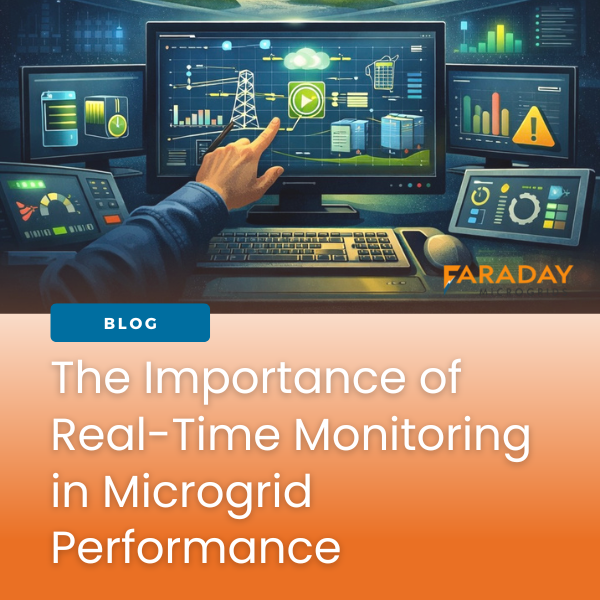
Think of it as your facility’s energy command center. Instead of waiting for something to break, you’re constantly informed and ready to act.
Technologies Behind Real-Time Microgrid Monitoring
Modern microgrid monitoring systems include a suite of advanced components:
- Smart meters and submetering – Track energy use down to the system or equipment level.
- IoT sensors and PLCs (Programmable Logic Controllers) – Enable remote, real-time data collection and system control.
- Edge controllers – Devices like microgrid controllers make decisions locally to keep the system stable, even if the internet goes down.
- Cloud-based dashboards – Centralized visualization tools provide alerts, KPIs, and historical data to operators and stakeholders.
- AI/ML analytics (optional) – Some systems use machine learning to detect anomalies and optimize performance automatically over time.
Faraday Microgrids designs systems that fit your facility, making sure the monitoring works for your specific equipment, energy use, and goals.
Why Work with Faraday?
With Faraday, real-time monitoring isn’t an add-on, it’s built into every microgrid we deliver.
We handle the entire process:
✔ Assess your needs
✔ Design and install your system
✔ Set up smart monitoring with clear, easy-to-use dashboards
✔ Provide ongoing support after installation
No jargon. No guesswork. Just a reliable system you can understand and control.
Whether you manage a hospital, data center, or industrial site, we’ll help you:
- Cut energy costs
- Avoid equipment failures
- Improve power quality
- Make better, data-driven decisions
You can’t manage what you can’t see. Let Faraday give you the tools to take control of your energy, easily, affordably, and smartly.
Take control of your energy future, start with a conversation.