Skip to content

Faraday Financing

You’re not buying a microgrid. You’re locking in lower energy costs.

Commercial customers arent trying to find a cap-ex project. They are trying to find a predictable, lower energy bill with backup as a bonus. Faraday closes that gap with financing options.

Whether it is a PPA, an equipment lease, or an outright cash sale, our business models serve a single purpose: reduce energy expenses with no impact on operations.

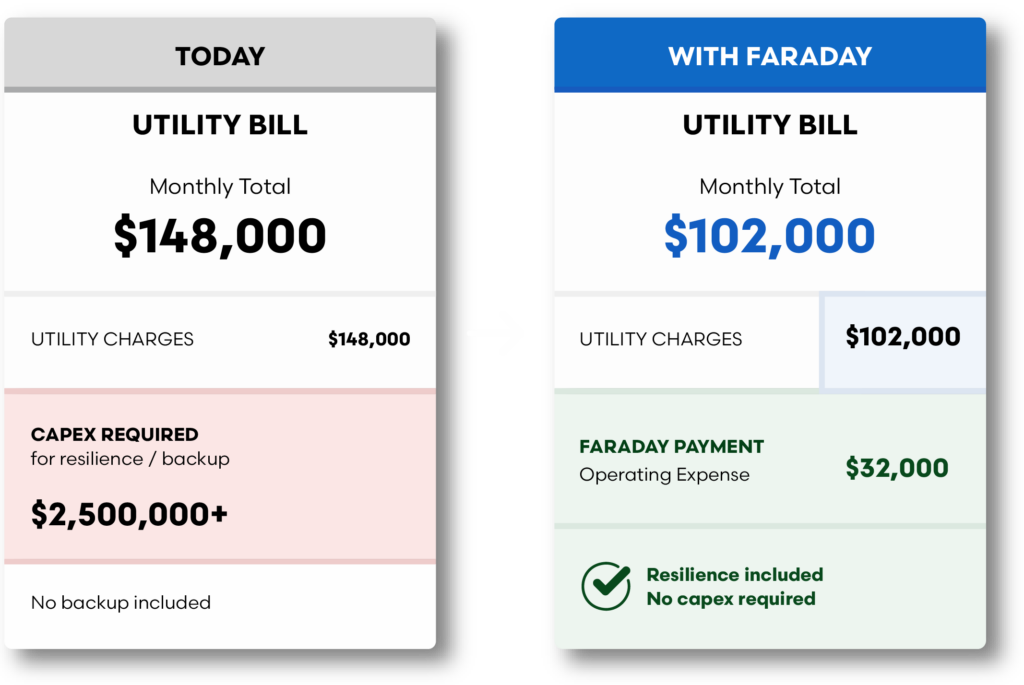
Operating expense, not capex. Faraday-provided PPA financing. Your facility runs on the same site, the same energy, more reliably, for less.

What you’re actually buying isn’t equipment. It’s an energy-cost structure.

There are really two components to the commercial microgrid deal in the buyer’s mind: the physical gear (solar, storage, controls, switchgear, and even the islanding controls system itself) and the result (reduced, more predictable cost, reliable backup power for defined loads, etc.). A commercial buyer of a microgrid in Faraday’s commercial portfolio is not actually looking to be in the equipment business; he’s looking for the outcome. What follows below, PPA, equipment lease, cash purchase, are simply three very different paths for delivering that same outcome given a range of different risk tolerance, tax situations, balance sheet characteristics, and procurement realities.

We offer all of these financing structures and do not require you to assume the burdens of owning physical assets.

Status Quo (your bill today)
With Faraday + PPA
Utility bill: full amount, monthly
Utility bill: lower (you keep paying the utility, but for less energy)

Three financing paths at a glance.

Same project. Three financing structures. The table below is the CFO-facing comparison. Detail on each path follows below.

Attribute
Faraday PPA
Equipment Lease
Cash Purchase
Capex required from host
$0
$0 (FMV operating lease) to ~10–20% (capital lease, varies)
Full project cost

Path 1 Power Purchase Agreement (PPA)

Under a Faraday PPA, Faraday finances the project, holds the operating asset, and operates the microgrid equipment on your site. You pay for the energy the system produces — typically on a $/kWh basis or a fixed monthly fee — at a rate below your current utility cost. No capex. Operating expense. The most common Faraday commercial structure.

How it works

Faraday designs, engineers, constructs, and finances the project under a long-term Power Purchase Agreement. You sign with Faraday. You pay Faraday for energy delivered. Faraday remains the integrator and ongoing operator under the same agreement. One counterparty across the life of the system.

Term and rate structure

Term length typically 15–25 years (the 20-year midpoint is most common). Rate structure: either a $/kWh rate with an annual escalator at or below typical utility-rate inflation (commonly 1.5–2.5% versus utility rates rising 4–7%), or a fixed monthly payment. Net effect across the term: a piece of your utility bill replaced by a Faraday payment that rises slower than the utility piece it replaces.

Counterparty and credit

Faraday is the counterparty on the energy agreement. Host facility credit qualification is part of the engagement process and is straightforward for typical California commercial-credit buyers. Faraday’s PPA program is structured for portfolio-grade financial discipline.

End-of-term options

At the end of the PPA term, you typically have three options: (1) renew the PPA at a renewal rate; (2) buy out the equipment at fair market value; (3) remove the equipment at Faraday cost, sometimes with host cost-share depending on structure. Specifics are part of the engagement.

Best fit for

Buyers prioritizing zero capex, off-balance-sheet treatment, no tax appetite for ITC monetization, and a clear conversion of capital-project framing into operating-expense framing.

Path 2 Equipment Lease

Under an equipment lease, a leasing partner (typically a tax-equity firm or commercial-equipment financier) owns the microgrid equipment and leases it to your facility. You pay a fixed monthly lease payment. End-of-term you have buyout, return, or renewal options depending on the lease structure.

How it works

Faraday designs and constructs. The lessor funds the project, takes title to the equipment, monetizes the ITC and depreciation, and leases the asset to your facility. Your facility pays a fixed monthly lease payment. Faraday remains the integrator and ongoing operator under a separate O&M arrangement.

Term and structure

Term length typically 10–15 years. Structure can be operating lease (right-of-use asset and lease liability under ASC 842) or capital / finance lease (capitalized on the host’s balance sheet from inception). Buyout structure varies: $1-buyout structures look economically like ownership; FMV-buyout structures preserve operating-lease classification.

Tax and accounting

The lessor claims ITC and MACRS depreciation; the pricing reflects those tax benefits passed through. For most host facilities under ASC 842, an FMV-buyout operating lease produces a right-of-use asset and a lease liability on the balance sheet, with the periodic expense flowing through P&L on a straight-line basis. Buyers wanting the cleanest operating-expense treatment often prefer the PPA structure.

Best fit for

Buyers wanting eventual asset ownership, operating-lease treatment, balance-sheet flexibility, or a tax-equity-monetization pass-through without committing to direct ITC monetization.

CFO depth — ASC 842. Under ASC 842, all leases over 12 months in length produce a right-of-use asset and a lease liability on the balance sheet. The operating-vs-capital distinction now affects P&L expense recognition rather than balance-sheet capitalization: operating leases produce straight-line lease expense; capital / finance leases produce front-loaded interest expense plus straight-line ROU amortization. Classification turns on the five tests — ownership transfer, bargain purchase option, lease term versus economic life, present value of payments versus fair value, and asset specialization. For a 12-year microgrid lease with FMV buyout, operating-lease classification is typical; for a $1-buyout structure or a term covering most of the asset’s useful life, finance-lease classification is the typical outcome. The Faraday Feasibility Study quantifies the ROU asset, the lease liability, and the P&L profile against your facility’s specific structure.

Path 3 Cash Purchase (and when it makes sense)

Most California commercial buyers are not in the equipment-ownership business. A microgrid is not a strategic asset in the way a production line or a piece of real estate is — it’s an energy-cost-structure investment. The PPA and lease structures convert that investment from a capital project into an operating expense without changing the underlying economics. For most commercial buyers, that’s the right framing. Some buyers, however, have specific reasons to own the equipment directly. Cash purchase is the path for them.

How it works

Under a cash purchase, your facility funds the project, owns the equipment, claims the ITC directly (subject to tax appetite), claims MACRS depreciation, and operates the asset on your own balance sheet. Faraday designs, engineers, constructs, and supports under separate engineering, EPC, and O&M contracts. No third-party financing partner is in the structure.

When cash purchase is the right answer

Three patterns. First — internal IRR target and tax appetite. Your organization can fully monetize the ITC and you target internal-IRR projects above your hurdle rate. The cash IRR on a California commercial microgrid project commonly clears 10–15% on direct-ownership economics, depending on project sizing, rate schedule, and useful-life assumptions. Second — asset-ownership strategy. Your real-estate posture is owner-occupied long-hold, and on-site energy infrastructure increases site valuation under your hold model. Third — avoidance of long-term contract counterparty. Your CFO posture is to minimize long-term off-take agreements and contractual energy commitments. Direct ownership keeps the energy decision inside the firm.

What you give up

Cash purchase trades the operating-expense treatment of PPA and lease for direct capital exposure and asset-ownership responsibility. The ITC monetization risk is yours. The equipment-end-of-life decision is yours. The project does pencil out for the right buyer — it just isn’t the default.

The same project, three financing paths.

Facility profile. Cold-storage / refrigerated-warehouse facility, approximately 50,000 sq ft, served on PG&E rate schedule B-20 Primary Voltage. Annual peak demand approximately 1,200 kW. Annual consumption approximately 7,000,000 kWh. Status-quo annual utility bill approximately $1.78MM, with annual demand charges approximately $650K (about 36% of the bill).

System concept. Faraday Endurance — approximately 2,000 kW DC solar PV (rooftop primary plus carport secondary), approximately 3,000 kW / 12,000 kWh battery, automatic islanding on selected critical loads (approximately 800 kW critical-load envelope), 4–12 hours of battery support. Pre-engineered, configurable, right-sized to the facility.

Numbers above are illustrative, calibrated against Faraday’s Feasibility Study Sample Report for a cold-storage facility on PG&E B-20. Your facility’s actual numbers depend on your load profile, your rate schedule as currently billed, your critical-load envelope, your tax position, and the financing terms quoted at the engagement stage. The Faraday Feasibility Study runs all three structures against your specific data.

How Faraday structures financing.

Faraday’s role across all three financing paths is the same: design, engineering, construction, and ongoing operations. What changes is who holds the financing and how the counterparty structure works.

1

PPA Structure

Faraday-provided PPA financing. You sign the PPA with Faraday; Faraday holds the customer relationship and is the counterparty for the energy agreement. One contract, one counterparty, across the life of the system.

2

Equipment Lease Structure

Faraday partners with commercial-equipment lessors — typically tax-equity firms or specialty-finance partners with renewable-energy and microgrid asset experience. The lessor funds and owns the equipment, leases to the host facility, and contracts with Faraday under a separate EPC and O&M arrangement. Different counterparty structure than the PPA path; chosen by buyers who want operating-lease treatment, balance-sheet flexibility, or eventual asset ownership.

3

Cash Purchase Structure

No financing counterparty. The host facility funds and owns the equipment. Faraday delivers under direct EPC and O&M contracts with the host.

Common questions about financing

Cash purchase is honest for the right buyer — sophisticated buyers with ITC monetization capacity, internal-IRR targets, and an asset-ownership strategy posture. For most California commercial buyers, the operating-expense framing of PPA or equipment lease delivers the same outcome (lower energy cost, more predictable cost, backup power) without putting capex on the balance sheet. We lead with PPA because it’s the right answer for most buyers. We’re happy to structure cash purchase for buyers who choose it.

Under a PPA, you pay for energy delivered — either as $/kWh on actual generation or as a fixed monthly fee tied to a guaranteed-output structure. Under a lease, you pay a fixed monthly lease payment regardless of energy delivered. The PPA is therefore output-correlated; the lease is fixed. The PPA is typically off-balance-sheet for the host; the lease typically creates a right-of-use asset and a lease liability on the balance sheet under ASC 842. Most California commercial buyers prefer the PPA structure; some prefer the lease for balance-sheet flexibility, eventual asset ownership, or specific tax-position reasons.

Faraday-side financing holds the equipment ownership; you do not own the asset under a PPA. Faraday operates the system on your site, monetizes the relevant tax benefits at the financing-entity level, and contracts with you under the energy services agreement. End-of-term you have buyout, renewal, or removal options per the contract.

The PPA financing entity claims the ITC and MACRS depreciation at the entity level. Faraday’s PPA pricing reflects the tax-benefit monetization — the economics flow through to you as a lower PPA rate. The host facility doesn’t directly claim the ITC; the value is built into the rate you sign.

Most California commercial organizations can — including LLCs, corporations, public agencies (with appropriate procurement compatibility), and non-profits. PPAs are routine commercial contracts with assignment, default, and remedy provisions designed for long-term off-take. Some structures (public agencies, public-sector procurement) require specific contracting compatibility; we work through those at engagement.

Yes. Faraday runs a host-credit review at the engagement stage. Typical California commercial-credit buyers clear it without friction. The review looks at credit history, financial stability, occupancy and lease posture (for non-owner-occupied sites), and counterparty diversification at the financing-entity level. We walk through what the credit conversation looks like as part of the engagement.

Ready to see your specific numbers?

Start with a free 30-minute screening call, or go straight to the Faraday Feasibility Study to see PPA, lease, and cash-purchase economics calculated for your specific facility.