
Faraday Microgrid Tiers — Endurance
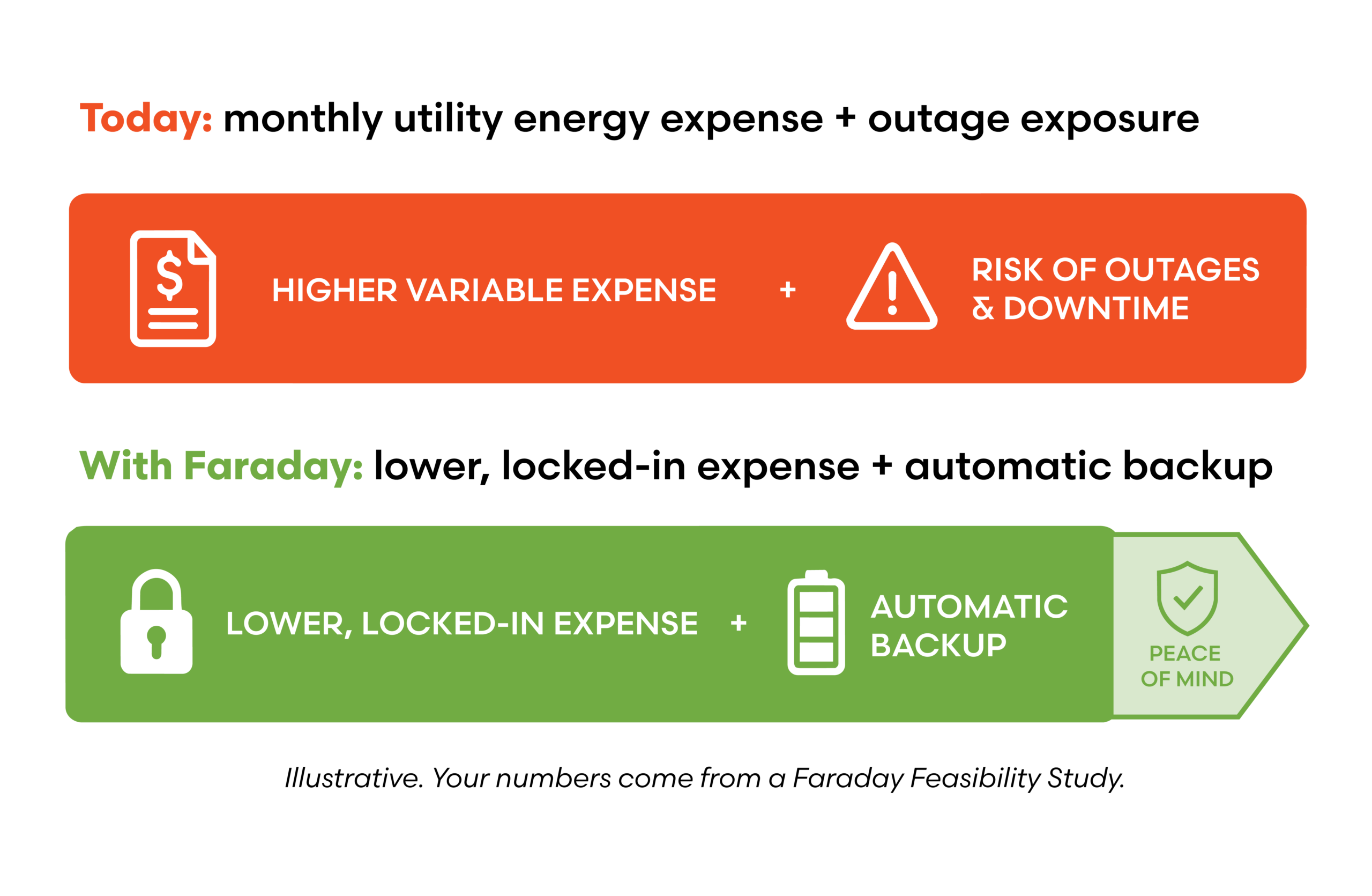
Lower energy operating costs. Keep your critical loads running. One operating expense.
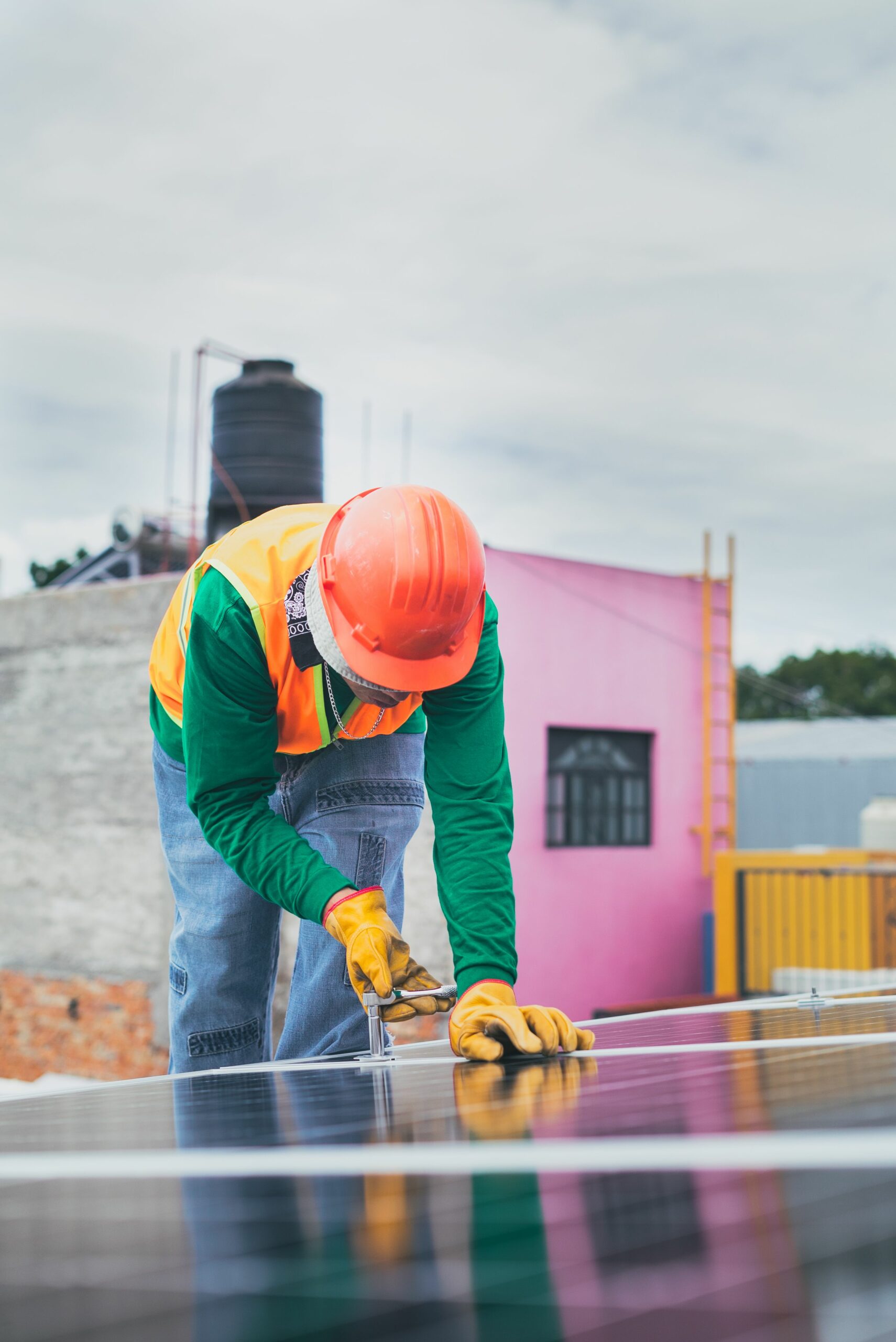
Ensure that your critical loads continue to operate during 4-12 hours of power failure, and pay only one operating cost through power purchase agreement or equipment leasing. No capex needed.

Endurance is engineered for facilities where the financial consequences of power failure are serious.

Faraday Endurance fits four operational profiles where 4–12 hours of automatic backup, paired with daily energy-cost reduction, is the right resilience match.

Cold Storage & Refrigerated Logistics
Refrigerated warehouses, distribution centers, and cold chain facilities. High risk of demand charges due to continuous 24/7 cooling loads. Risk of spoilage begins hours after loss of power — and the associated insurance costs follow immediately thereafter.
Food & Beverage Processing
Food, beverages, and agri-processing plants. Cycles of reordering, down time due to sanitizing, and product spoilage make a partial-day disruption exceedingly costly. Charges for demand are already the dominant part of the utility cost in most California plants.
Biotech, Pharma & Discrete Manufacturing
Lab or production facilities where temperature-sensitive storage, critical equipment, or quality assurance processes result in outage costs through downtime, sample loss, or scrap. Does not include semiconductor fabrication facilities.
Manufacturing & Multi-tenant Commercial
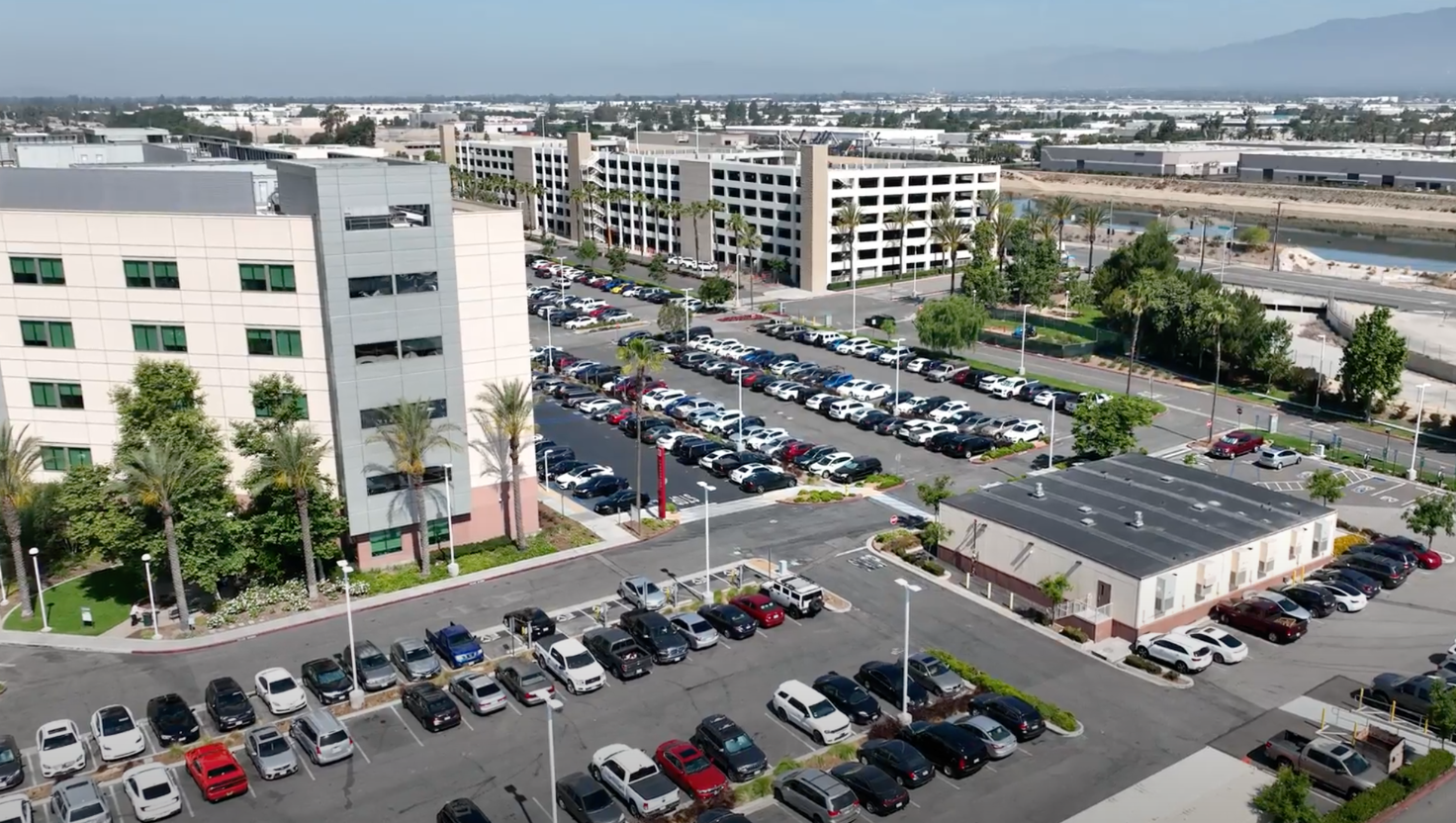
Industries or commercial tenants where demand costs make up a large percentage of utility bills. This includes medium-sized manufacturing facilities, large retail centers with grocery anchors, and large industrial facilities. Demand costs tend to be 30%-50% of the utility bill.
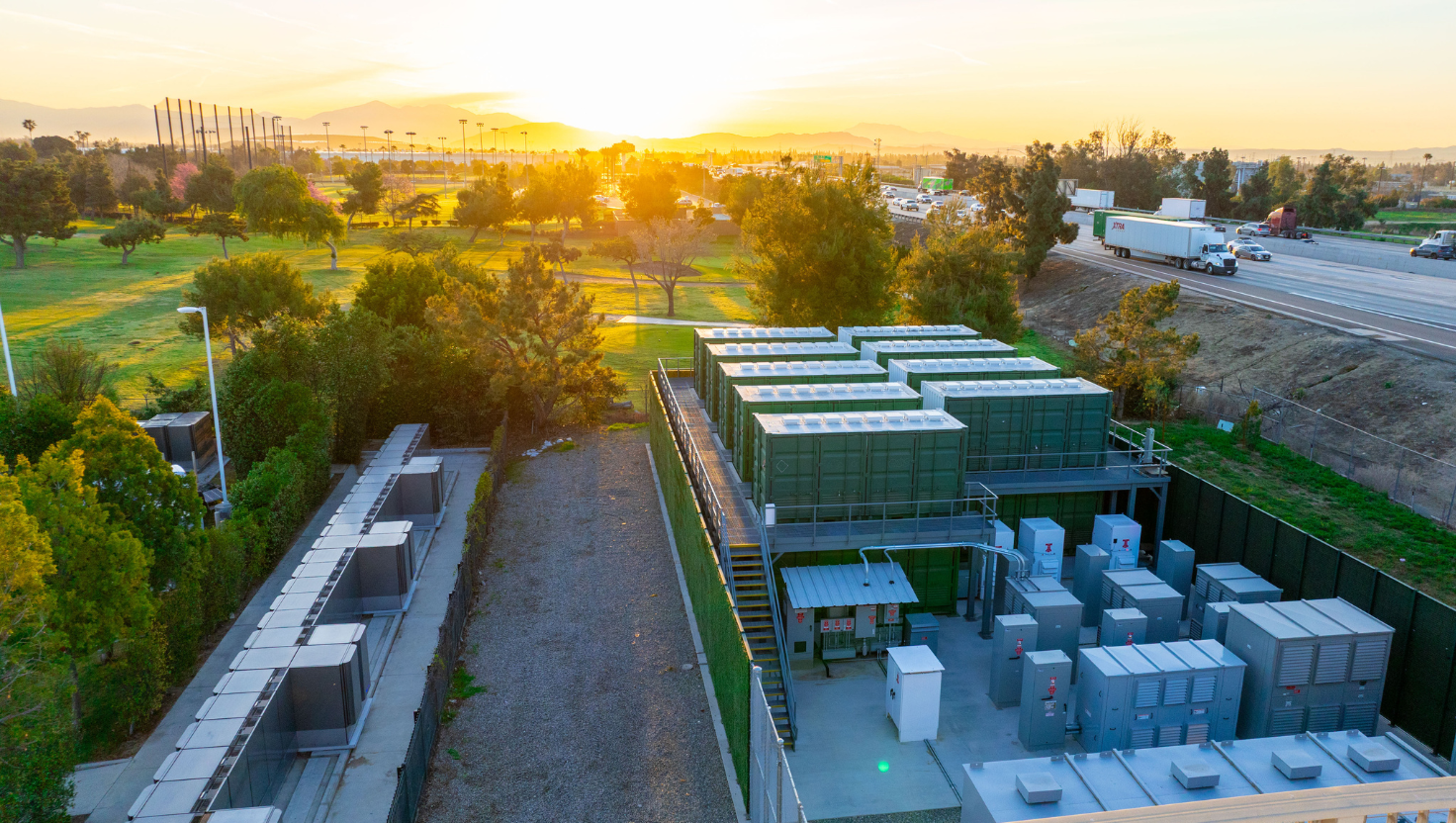
What’s in a Faraday Endurance system.
Components
- Solar PV — sized to the facility’s load profile and roof / ground-mount footprint.
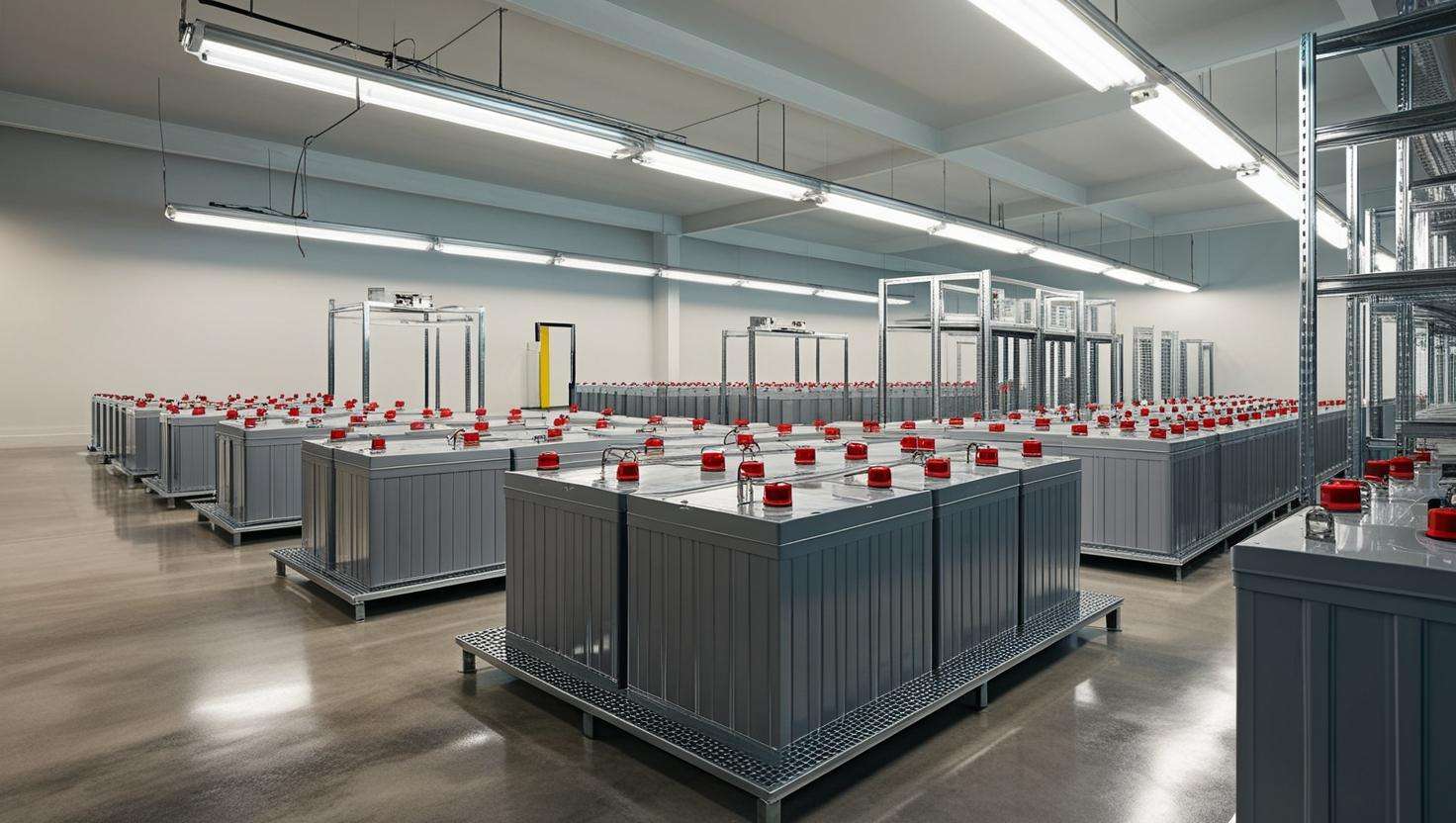
- Battery storage — sized for 4–12 hours of backup on selected critical loads, plus daily peak-shaving and time-of-use arbitrage.
- Islanding-capable inverter and protective controls — automatic disconnect from the grid during outages, automatic resynchronization on grid restoration. No operator intervention.
- Critical-loads partitioning — switchgear and panel work to isolate the loads you choose to keep running through outages.
How it operates
On an ordinary day, the solar panels generate electricity that powers the facility itself, while any excess energy is stored in the battery. The battery dispatches during expensive on-peak hours to reduce energy charges, and shaves peak demand to reduce demand charges. Most California commercial bills are dominated by demand charges; this is where Endurance produces the most consistent value on non-outage days.
During a grid outage, the islanding inverter detects the grid failure within milliseconds, disconnects from the utility, and carries the critical-loads panel on battery power.
While the solar panels keep generating during daylight, it extends the time the battery lasts. The system manages critical loads on its own for 4-12 hours using only the battery power, and for more than that period with the help of solar during the daylight. In case the grid power restores, the system automatically gets synchronized and goes back into the grid-tied mode without any action on the part of the operator.
In case your facility has an existing backup generator (and most Endurance facilities have one, and most keep one), then the controls work together in a way that the battery covers the fast transients and peaks while the generator takes care of the extended outage and loads above the battery. Most Endurance facilities find themselves operating the generator much less often compared to before.
One line item. Two benefits. A reduction in costs and automatic backup.
For example, if your site operates in any of the four Endurance verticals, the energy costs that you pay are not all of the operating risks you face. If there’s an eight-hour outage during a period of a heat wave, you lose the energy costs that were never charged to you AND the spoilage, lost shipment, or lost production that you absorbed as cost. Most of the commercial users in California have priced both of these risks. Most are unaware that just one purchase can solve both.
As a PPA or equipment leasing option, the Faraday Endurance microgrid system doesn’t require any capital investment. The operating expense that you pay for energy operation to the utility company becomes an operating expense payable to Faraday. And the risk of outages, which you have costed separately, comes under one line item: 4-12 hours of automatic backup for certain critical loads for each and every grid event without any operator involvement.
Why “just a generator” or “just a battery” leaves money on the table.
Most California commercial buyers compare a Faraday Endurance install against three alternatives. Each delivers only part of what Endurance delivers.
A battery alone
Systems installed without an inverter or controls are generally only set up to reduce bills. They’re not designed for islanding during grid outages. Islanding capability will need to be added later through replacement of the inverter along with installation of the critical loads panel at significantly greater cost than incorporating it initially. Faraday incorporates islanding capability upfront in its inverter design and control system design.
A generator alone
The standby generator remains idle for 99% of the year. It only delivers its utility during blackouts and has no value on any other day. At the same time, you incur full retail electricity costs and demand costs each month when the grid is operational. Endurance solves that – the battery helps reduce demand charges and trades off-peak electricity on days without blackouts, but takes over during blackouts. The generator (if you keep one) will run less often, will incur lower operating costs, and avoids California air district regulations.
Solar alone
Solar systems that don’t include storage will generate electricity during the day and sell any excess at the new Net Billing Tariff price, which is about 75 to 80 percent cheaper than the NEM 2.0 export payment price. The economic fulcrum has been moved from “solar for exporting” to “solar + storage for consumption.” In addition, solar without storage does nothing during outages, because grid-connected solar systems will shut off their operation in case of grid failure. Endurance does both of these things.
Do you need more than 12 hours? Consider Faraday Independence.
For most California commercial sites, 4–12 hours of automatic battery backup, supplemented by daytime solar, is enough to ride through grid events without operational disruption. For some, it isn’t. Multi-day Public Safety Power Shutoff exposure, continuous-process manufacturing where any unplanned downtime is unacceptable, and mission-critical operations in PG&E high-fire-threat districts often require backup measured in days, not hours.
How Endurance gets paid for.
Most Faraday Endurance installations are purchased through a Power Purchase Agreement: Faraday owns and operates the system; the host pays a contracted per-kWh rate for what’s produced and consumed on-site, designed to deliver day-one savings against the current utility bill. There is no upfront capital expenditure.
Cash purchase is available for buyers who specifically want to own the asset directly. Simple payback typically lands in the 4–7 year range with the current ITC. Every Faraday Feasibility Study compares both structures with site-specific economics. The Study is the path to your numbers.
If Faraday can keep a Level 1 trauma center running, your commercial Endurance install is a smaller version of work we’ve already executed.
Faraday was responsible for designing and installing the first islandable acute-care hospital microgrid in the United States – Kaiser Permanente Ontario, supplying a Level 1 trauma center with 2.2 MW of solar energy, 9 MWh of batteries, and 1 MW of fuel cell. The system can automatically isolate the hospital emergency power supply in case of grid disturbances and influenced the code changes for the National Electrical Code, regulating the relationship between microgrids and hospital emergency systems.
Commercial Endurance installation is a smaller but still complex version of the same project – similar control philosophy, similar islanding design, similar engineering approach, and much less regulation. Hospital project experience is not what Faraday sells to commercial customers; it is what Faraday brings to the table.
Common questions about Endurance.
Any critical loads that you decide to assign to the critical load panel during the engineering phase – from nothing up to all of your facility’s loads. Examples might be refrigeration or cold storage compressors, critical process equipment, life safety, partial lighting, and security systems. This is key when sizing your batteries – the more critical loads the bigger the battery.
A standby generator is idle 99%-plus of the time and produces backup value only during outages. Endurance’s battery, by contrast, produces daily bill savings every non-outage day by shaving peak demand and arbitraging time-of-use rates. Over a 20-year horizon, the operating-cost savings dwarf the backup value — and those savings are what make Endurance work as a PPA or lease with no capex. Endurance also eliminates the diesel supply chain, emissions permits, and air-district scrutiny that come with a standby generator.
A typical Endurance system powers selected critical loads for 4–12 hours on battery alone, with solar extending daytime runtime. For a PSPS that lasts the better part of a day, that is often sufficient. For multi-day PSPS events common in California fire-country territories, Endurance is usually paired with an existing standby generator for continuing runtime, or upgraded to Independence for multi-day extended-duration backup without diesel. Facilities in PG&E high fire-threat districts should treat multi-day outage capability as a design requirement, not an option.
Endurance project cost scales with facility size, system capacity, resilience scope, and site complexity. Faraday does not publish project price ranges — the Feasibility Study is the path to a site-specific number. Under PPA or lease, there is no upfront capital expenditure; the host pays a monthly or per-kWh rate designed to produce day-one savings against the current utility bill. Under cash purchase, simple payback typically lands in 4–7 years with the current ITC. The deciding number for most CFOs is monthly cash flow before vs. after install — not headline project cost.
Find out if Endurance is the right fit for your site.
A free 30-minute screening call. If your facility is a fit, the next step is a 30-day, fixed-fee Feasibility Study — and the Study fee credits 100% toward your installation contract if you proceed.