

Skip to content

Microgrid 101

What a commercial microgrid is and how to find out if your facility needs one.

A plain-English guide for California commercial and industrial decision-makers. .

Read end-to-end, take the 2-minute self-assessment, or skip ahead to the Feasibility Study.

What a commercial microgrid actually is

A commercial microgrid is your facility’s energy system, organized.

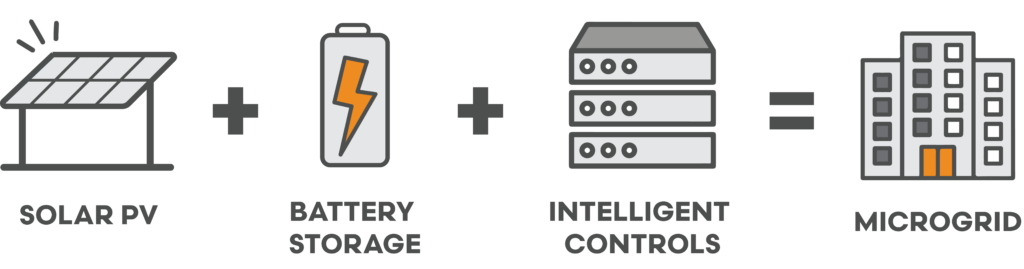
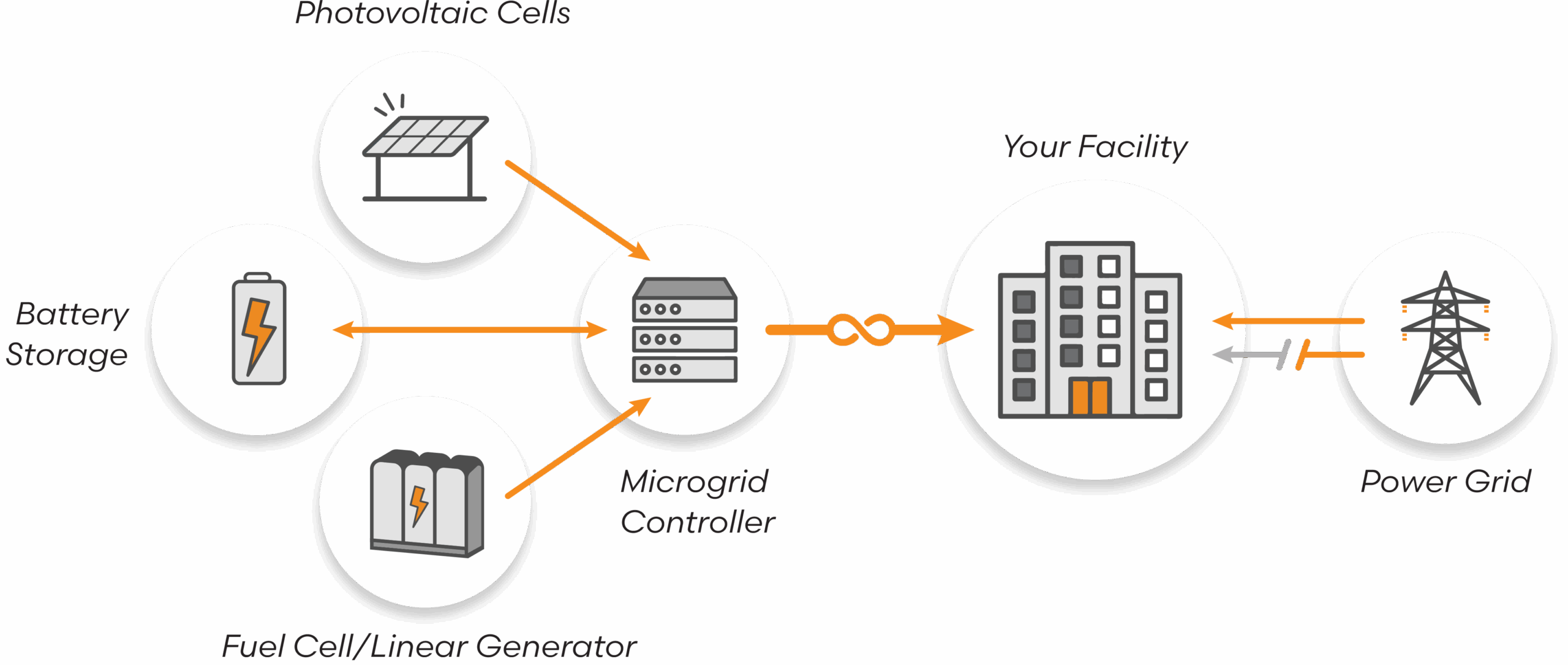
A commercial microgrid combines on-site solar power, battery energy storage, and intelligent controls to help businesses reduce energy costs, improve energy resilience, and maintain operations during power outages. For most California commercial and industrial facilities, the system includes solar panels that generate electricity, batteries that store excess energy, and advanced microgrid controls that continuously determine the most efficient energy source to use, whether that’s solar, battery power, utility power, or a combination of all three.

During normal operations, the microgrid works alongside the utility grid to optimize energy usage and lower electricity costs. When a utility outage occurs, the system automatically disconnects from the grid and transitions into “island mode,” allowing critical business operations to continue running on local power. The result is a more resilient, energy-independent facility with greater control over energy costs and reduced exposure to grid disruptions.

How a microgrid operates day-to-day vs. during a grid outage

Two modes of operation. One system.

Day-to-day

On most days, the system remains tied to the utility. The controller sends solar power to the facility first, then charges the battery with the surplus of solar power, using the battery power for peak shaving during costly utility hours. The utility makes up for any shortfall. The end result is a lower and predictable monthly cost of energy supply. No unexpected costs in the “demand charge” row anymore; no spikes during time-of-use events for the operations team to handle.

During an outage

When the grid goes down, your business doesn't have to. In the event of a wildfire-related shutoff, PSPS event, severe weather outage, or utility equipment failure, the microgrid automatically disconnects from the grid and switches to on-site solar and battery power. Critical systems continue operating without interruption, keeping your facility running when others may be offline. No manual intervention. No scrambling to start generators. Just reliable backup power when you need it most.

What a microgrid does for a California commercial site

Four things a microgrid does for a California commercial site

1

Reduction of demand charges

Battery dispatching occurs during times when the utility company charges highest, and as such, it reduces demand peak metered by the utility and hence billed. For the majority of California commercial properties, demand charge represents the largest cost in the electricity bill.

2

Stabilizes monthly energy expense

The unpredictability of time-of-use pricing, the variability of demand charges, and rate case adjustments all have less impact on the cost portion you pay every month. With the microgrid, utility variability is managed to create a more consistent monthly cost at your facility.

3

Keeps critical loads powered through outages

In the case of a power outage from the utility provider — planned or otherwise — the microgrid operates independently to maintain power to those loads identified in the design phase.

Defers or eliminates a generator

For most commercial customers in California, the microgrid is the system replacing a diesel generator on your budget sheet, with fewer delivery trucks of fossil fuel, fewer permits for emissions, and less pollution when operating.
Picture Capability #1. The dashed line represents your facility’s daily load profile. The colored section is where your battery discharges to keep your peak load from exceeding the utility’s metered level.

Why California commercial buyers are looking at microgrids now.

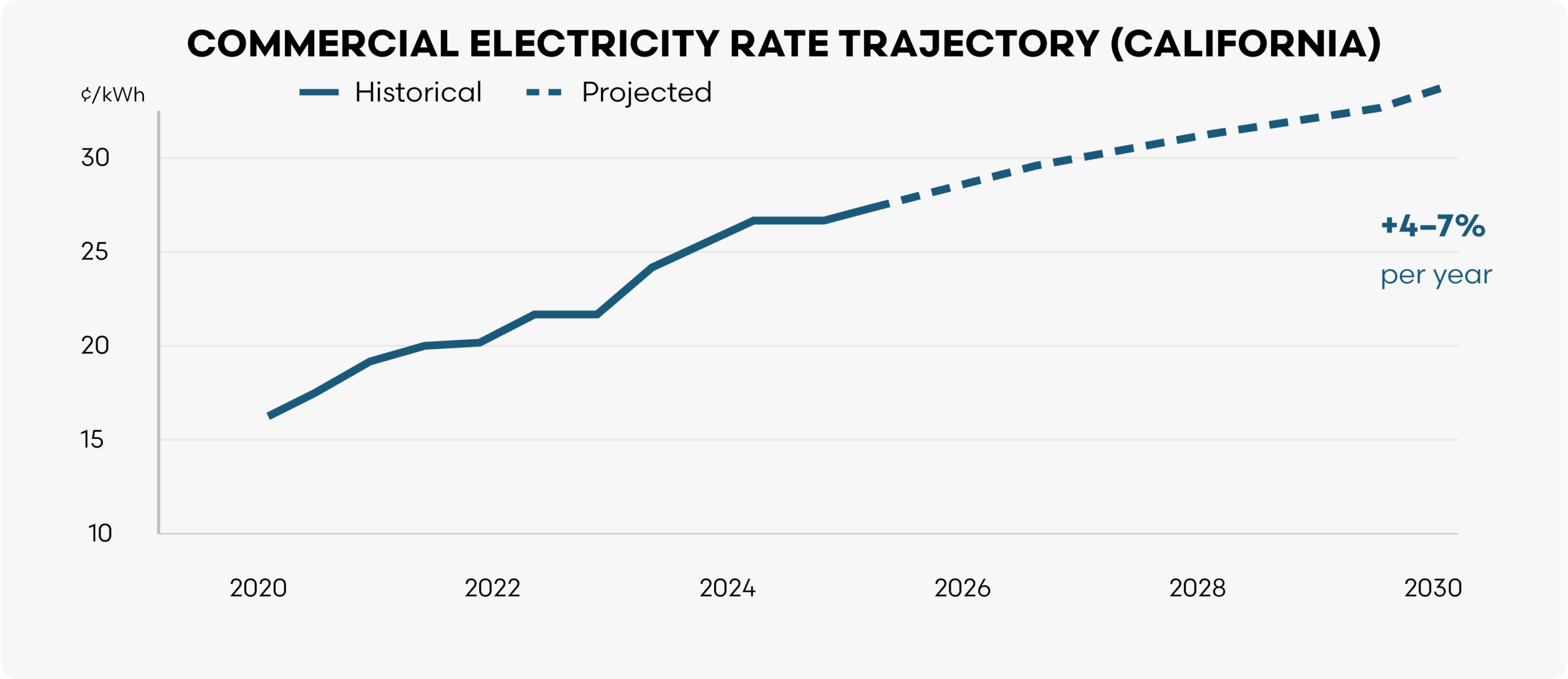
California’s three large investor-owned utilities (PG&E, SCE, SDG&E) have all filed multi-year rate cases that increase commercial rates above the rate of general inflation. The cost of doing nothing is no longer flat, it’s a rising curve.

California, with its Net Billing Tariff implemented as of 2023, generates much less money from its exported energy than the old NEM 2.0 program. This shift in policy means that self-consumption with energy storage is more economical than export and credits; the microgrid structure makes self-consumption with storage possible.

Commercial California operations in wildfire zones are subject to PSPS, which can range in duration from hours to days. Grid-equipment-caused disruptions outside of PSPS time periods are increasing. There is no longer a separate facility-based cost for shutting down an operation due to unforeseen conditions; it’s all part of the energy discussion.

The 30% ITC under §48E remains available for projects that meet safe-harbor requirements before the published transition date. Projects that miss the window face a different credit structure or no credit at all. The domestic-content, he energy-community, and low-income adders depend on site eligibility and government rule-making.

The right way to think about a California commercial microgrid isn’t “should I add a capital project to my budget.” It’s: you are already paying for energy. Today that payment goes to the utility on a non-contracted, rising curve with embedded outage risk. A microgrid swaps that payment for a lower, contracted monthly expense to Faraday under a financing structure that includes resilience as part of the package. Same line item. Different counterparty. Lower number. More predictable. Outage-resilient.

Is a microgrid right for your facility?

Answer six quick questions and get an initial recommendation in about two minutes. We’ll help you identify the Faraday tier that appears to be the best fit based on your goals and operating needs. From there, a Feasibility Study confirms the recommendation using your real utility data, energy usage patterns, and rate schedule.

What a commercial microgrid is not.

1

Not a backup generator

The generator uses either diesel or natural gas for fuel, remains idle for 99% of the time, and only pays for itself when there is an outage. The microgrid works every single day, cutting down on demand costs, managing the solar power, maintaining the power bill, and also making sure that there is electricity even during an outage.

2

Not solar by itself

The pure solar PV system generates electricity solely during sunny periods, sends out its excess to the utility under the new NEM 3.0 system and ceases operations whenever there is a blackout in the grid. The microgrid system comprises a solar PV system along with batteries to store energy generated from the solar system.

3

Not a UPS

A UPS or uninterruptible power supply covers seconds up to minutes of power failure for certain critical pieces of machinery, such as a rack of servers or a control room. On the other hand, a microgrid is designed to cover hours or days of energy generation and usage within an establishment.

Not a residential battery scaled up

Whereas a battery for domestic purposes will be a device below 20 kWh in capacity that suits the needs of one single home, a commercial microgrid is an altogether different concept with typical installations comprising hundreds of kilowatts of solar coupled with several megawatt-hours of battery storage capacity. The only similarity between them would be in their chemistry.


Faraday’s commercial microgrid product line in one screen.

Each level represents a microgrid solution for California Commercial properties with a particular profile, each level being offered at an all-inclusive price, each being implemented within a set period of time. Most commercial facilities in California are Endurance level customers. Below is just the starting point, where the feasibility study determines the correct level for your facility.

The Feasibility Study is how you find out if it pencils for your site

The reading is the starting point. The Study is the answer.

Our Microgrid 101 resources and self-assessment tool are great starting points for understanding whether a commercial microgrid may be a good fit for your facility. However, they can only provide general guidance. They don’t account for your actual energy usage, utility rate structure, critical loads, available incentives, or site-specific constraints that can significantly impact project performance and economics.

That’s where the Faraday Feasibility Study comes in. This fixed-fee, fixed-scope analysis provides a detailed evaluation of your facility, including energy data review, microgrid system design, financial modeling, incentive analysis, and financing options such as a Power Purchase Agreement (PPA), equipment lease, or direct purchase. The result is a clear recommendation on whether a microgrid makes sense for your business, which tier is the best fit, and what the expected financial and operational outcomes will be.

If you move forward with installation, the full cost of the Feasibility Study is credited toward your project.

Common questions, quickly answered

The correct framing of cost is monthly payment rather than lump sum. California business people usually get financing of their system through either a Power Purchase Agreement or an equipment lease; making regular payments that are less than the utility cost that is replaced. This is done on a monthly basis. The Feasibility Study provides the exact cost of your installation in PPA, leasing, and cash purchase form.

Feasibility Study duration from data release to completion of study report takes around 30 days. The timeline for installation from signing of installation contract to completion takes anywhere between 12-24 months, based on tier size, connection of utility, and equipment lead time.

Yes, most leased commercial properties have the ability to support a microgrid with an appropriate financing approach. The financing through power purchase agreement is ideal for leases with extended timelines. Properties with multiple tenants or short remaining lease terms require more structure, which is what the feasibility study is for.

The PPA contracts have assignment terms and counterparty protection terms. The physical plant remains at your facility location; the financing is an obligation within the contract which can be assigned to other parties. The Feasibility Study shows the exact counterparty protection measures included within the suggested financing structure.

The Study is engineering and financial analysis in their purest form – load data review, system sizing, incentive stack analysis, financial modeling, and system concept development. Free Studies pay for themselves through selling you unneeded scope. An upfront fee Study gives us aligned interests – we get paid whether the answer is “yes” or “no.”

Find out if a Faraday Microgrid is a fit for your site.

A free 30-minute screening call. If your facility is a fit, the next step is a 30-day, fixed-fee Feasibility Study.

